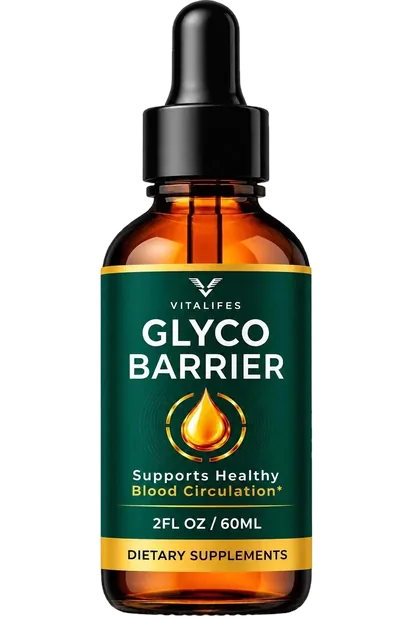
1 bottle
60 ml in total · 30 servings · 30 days at 1 ml twice daily, the only serving the label gives
- One 60 ml bottle, 30 servings
- 30 days at 1 ml twice daily
- Sealed bottle from our US stock
- Ships from the United States


60 ml · 30 servings of 2 ml
Official product information
GlycoBarrier is a 60 ml herbal dropper bottle sold for healthy blood circulation — not blood sugar, despite the name. One 121 mg proprietary blend of six botanicals, with no individual amount published. Thirty servings of 2 ml. Price and return terms are both shown at the seller’s checkout.
Sold by U.S. stocking partner for GlycoBarrier · +1 (302) 200-3480 · read the four things on this label that do not line up.


GlycoBarrier is a liquid herbal supplement sold by Glycozbarrier, the U.S. stocking partner for GlycoBarrier. One 60 ml dropper bottle holds thirty 2 ml servings, taken as 1 ml twice daily. The Supplement Facts panel prints a single 121 mg proprietary blend of six ingredients — gotu kola, Chinese hawthorn, horse chestnut, motherwort, butcher’s broom and grape seed — and not one individual amount. The claim on the front of the bottle is “Supports Healthy Blood Circulation*”. Prices show at the seller’s checkout.
If you read one more line, read this one: this product is not what its name suggests. “Glyco” means sugar, and most people arrive at a page like this one because of blood sugar. The claim printed on the bottle is blood circulation, and every ingredient on the panel is a vein or heart herb. That is the fact a summary of this product is most likely to get wrong, so it appears on every page of this site that touches the formula.
The second thing to know is that this label contradicts its own marketing in four separate places, and we have published all four rather than quietly picking whichever version reads better. They are a few screens down, under four things on this label that do not line up. One of them matters a great deal if you have diabetes.
Glyco- is the prefix for sugar. It is in glycogen, glycaemic, glycolysis. A product called GlycoBarrier, marketed with a headline reading “Balance your blood”, will be read by a great many people as a blood-sugar product. We think most of the traffic to pages like this one arrives expecting exactly that.
The claim actually printed on the front of the bottle is “Supports Healthy Blood Circulation*”. The brand's own benefits panel lists “supports healthy circulation” first. And when we looked up all six ingredients on the Supplement Facts panel at Memorial Sloan Kettering and NCCIH, not one of them had a glucose indication. They are vein herbs, and two of them have genuine vein research behind them.
So this is a circulation formula. That is not a criticism of the formula — it is a warning about the name. The ingredients page takes all six in order.
This product does not contain a single ingredient studied for glucose metabolism, and it contains one that Memorial Sloan Kettering tells people with diabetes not to take. If blood sugar is your reason for being here, the useful next step is a clinician, not this bottle. We would rather lose the sale than have that sentence go unsaid.
This is the whole formula. One line on the Supplement Facts panel, one total, six ingredients underneath it. Below is that line drawn as a graphic — with the important caveat printed on the graphic itself, because a chart that looks like a measurement when it is not is worse than no chart at all.

It is worth sitting with the figure. A 2 ml serving of this product carries 121 milligrams of blended botanical extract in total. Divided six ways, that is an average of about 20 mg per ingredient.
For comparison: horse chestnut vein trials use 300-600 mg a day. Butcher's broom trials use 150-300 mg. Hawthorn heart-failure trials run from 160 mg up to 1800 mg. Every one of those is larger than the entire blend in this bottle, and in the case of hawthorn by up to fifteen times.
Extracts do concentrate, which is a real caveat and one we take seriously. But no extract ratio is published for any of the six, so there is no arithmetic available that closes the gap. The full label page reproduces every line of the panel.
We read the bottle before we wrote a word of this site, and four things on it contradict each other or the marketing around it. A retail site would normally smooth these over and repeat the marketing line. We have printed all four instead, because you are about to swallow this and you should know what we know.
Glyco means sugar. The product is called GlycoBarrier, and the reason most people arrive at a page like this one is blood sugar. But the claim printed on the front of the bottle is “Supports Healthy Blood Circulation*”, and not one of the six ingredients on the Supplement Facts panel has a glucose indication in any source we could open. This is a vein and circulation formula wearing a blood-sugar name.
This follows directly from the first. Memorial Sloan Kettering’s butcher’s broom monograph carries a Do Not Take line: “You have diabetes (butcher’s broom was reported to cause diabetic ketoacidosis…)”, citing a case in a 39-year-old woman five days after she took it for mild ankle swelling. A product named for glucose contains an ingredient a cancer centre tells people with diabetes not to take.
The brand’s own ingredient panel names hawthorn, motherwort, grape seed and gotu kola. The Supplement Facts panel on the bottle adds horse chestnut extract and butcher’s broom extract — which happen to be the two ingredients in the formula carrying the most specific safety warnings of the six.
The ingredient panel is headlined “Liquid Drops straight from nature”. The Other Ingredients line on the same product reads: RO water, vegetable glycerin, natural flavor, sodium benzoate, potassium sorbate, malic acid, sucralose — two synthetic preservatives and an artificial sweetener.
Nothing except print them. We are a stocking partner, not the manufacturer, and we have no explanation to offer beyond what is on the bottle. If any of the four matters to your decision — and the second one should, if you have diabetes — the number to call before buying is +1 (302) 200-3480.
Everything in this table came from the bottle photographs or the seller pack we were given. Where a fact was not published, the table says so instead of guessing. There are more blanks in this one than we would like, and hiding them would not make them go away.
| Detail | What we were actually given |
|---|---|
| Product name | GlycoBarrier, printed on the bottle as GLYCO BARRIER |
| Front-of-bottle claim | “Supports Healthy Blood Circulation*” |
| Form | Liquid drops, taken by dropper |
| Bottle size | 2 fl oz / 60 ml |
| Serving size | 2 ml, taken as 1 ml twice daily |
| Servings per container | 30, so one bottle is thirty days |
| Blend name on the panel | Proprietary Blend |
| Blend total | 121 mg per 2 ml serving |
| Named on the panel | Gotu Kola Extract (leaf), Chinese Hawthorn Extract (fruit), Horse Chestnut Extract, Motherwort Extract, Butcher’s Broom Extract (root), Grape Seed Extract |
| Named in the marketing | Hawthorn, motherwort, grape seed, gotu kola — four of the six |
| Ingredient amounts | Not published. Six ingredients, one blend total, no individual figures |
| Extract ratios | Not published for any of the six |
| Other ingredients | RO Water, Vegetable Glycerin, Natural Flavor, Sodium Benzoate, Potassium Sorbate, Malic Acid, Sucralose |
| Contains sucralose? | Yes, plus sodium benzoate and potassium sorbate |
| Who it is for | Adults 18 and over |
| Distributed by | Vitalifes |
| Sold on this site by | U.S. stocking partner for GlycoBarrier |
| Price | Price at checkout. The seller pack routes pricing to the listing checkout |
| Returns | Procedure supplied; window length not published, see the listing |
| Best before | 12/2028 |
| Lot / certificate | GLY-26/GL-7587 / GLY-7587-26-GL — both marked as draft references, not lab proof |
| Customer rating | None published. The supplied review data was template layout copy |
| Market | United States |
Descending order of weight is the panel's own ordering, so the first card below is the largest share of the blend and the last is the smallest. Four of the six are named on the brand's marketing artwork; two are not, and those two carry the most specific safety warnings in the formula. Each card links to the full write-up, with the citation we actually read.
A vein herb with thin human evidence.
Chinese Hawthorn ExtractCrataegus species, fruitA heart herb, and the most-studied thing here.
Horse Chestnut ExtractAesculus hippocastanum, seedThe strongest vein evidence here, and the most serious safety file.
Motherwort ExtractLeonurus cardiaca, aerial partsA traditional heart herb with no reference page we could link.
Butcher's Broom ExtractRuscus aculeatus, rootReal vein evidence, and a diabetes warning.
Grape Seed ExtractVitis vinifera, seedAn antioxidant extract, studied mostly for cholesterol and blood pressure.
Hawthorn, motherwort, grape seed, gotu kola. Four names on the artwork, and they are the four most people will ever see, because artwork travels further than a bottle photograph.
The Supplement Facts panel adds horse chestnut extract and butcher’s broom extract. On the evidence those are the two best ingredients in the formula, and they carry the two most specific safety warnings of the six. A buyer reading only the marketing does not know either fact.
Note the headline too: straight from nature, over a product whose other-ingredients line includes sodium benzoate, potassium sorbate and sucralose.
One ingredient on this label carries no citation at all: motherwort. That is not an oversight. We searched NIH, NCCIH and Memorial Sloan Kettering — the three sources this site uses — and none holds a monograph on it, so we say so on the page rather than substituting a weaker source to fill the gap. Read all six in full.
This is the table most supplement sites will not print, because every row in the middle column says the same thing. It is the honest comparison: what the research uses, against what this label tells you it contains. The right-hand column is the one to read.
| Ingredient | Amount in GlycoBarrier | Typical amount in research | What that comparison is worth |
|---|---|---|---|
| Gotu Kola Extract | Not published | 60-180 mg a day of standardised extract | Possible within 121 mg only if gotu kola takes most of the blend. It is listed first, so it is the largest share — but the share is not published. |
| Chinese Hawthorn Extract | Not published | 160-1800 mg a day in heart-failure trials | Cannot be reached. The entire blend is 121 mg. Note also that trials use leaf-and-flower extract; this label specifies fruit. |
| Horse Chestnut Extract | Not published | 300-600 mg a day standardised to 50-150 mg aescin | Cannot be reached. A trial dose is two to five times the whole blend, and no aescin figure is published. |
| Motherwort Extract | Not published | No dose could be sourced | Cannot be compared at all. No NIH, NCCIH or MSK monograph exists for this ingredient. |
| Butcher’s Broom Extract | Not published | 150-300 mg a day in vein trials | Cannot be reached. Also the ingredient MSK tells people with diabetes to avoid. |
| Grape Seed Extract | Not published | 100-300 mg a day | Cannot be reached, and it is listed last, so it is the smallest share of the 121 mg. |
A serving delivers 121 mg of blended material in total. Four of the six ingredients on this label are studied at doses larger than the entire blend, and for one of them — hawthorn — the upper trial dose is roughly fifteen times the whole thing. That is not an accusation against this product; it is true of a great many multi-botanical liquids. It is a reason to keep expectations modest and to ignore anyone promising otherwise.
Seven steps, all of them drawn from the directions on the bottle or from the cautions in the sources we cite. Nothing here is invented, and where the label is silent we say that it is rather than choosing for you.
This is the first word of the label’s own instruction and it is not decoration. A botanical extract suspended in water and glycerin separates as it stands. A bottle that is not shaken delivers a different concentration at the start of the month than at the end, and you will have no way of knowing which.
The full instruction reads: “Shake bottle well. Take 1ml twice daily or as directed by your healthcare provider.” The dropper is the measuring device; a “squeeze” is not a unit. Two doses of 1 ml make the 2 ml serving the Supplement Facts panel is built around, which is what makes a 60 ml bottle last thirty days.
The label says this itself: “Check with your doctor before using this product if you are using medication or have any medical condition.” On this particular formula that line is doing real work — there are four named interactions on the safety page, and one of them concerns diabetes specifically.
The label does not name times of day, so this is your choice. Morning and evening, attached to meals you never skip, is the pattern most people manage. Consistency matters more than the hour, because the only way to judge a supplement with no published amounts is to hold everything else steady.
“Do not exceed recommended dose” is printed on the bottle. With a liquid this is easier to get wrong than with a capsule: a generous squeeze is not a measurement, and doubling an unitemised botanical blend is exactly the situation that line exists for.
The label says: “Store in a cool, dry place.” Amber glass is there to keep light out, which tells you the contents are light-sensitive. A kitchen cupboard away from the hob is good; a windowsill and a bathroom cabinet are the two worst places in most homes.
There is no honest timeline for this product, because there are no published amounts to base one on. Thirty days is one bottle and one clean test. Note anything you see, and be ready to conclude nothing happened — that is a legitimate outcome for a supplement, not a failure of your record-keeping.
The full how-to-use page covers what to do about a missed dose, whether to take it with food, why the dropper markings matter more on a liquid than people expect, and why we will not print a “results by week four” chart.
Six ingredients means six safety files, and this formula has more specific warnings attached to it than any product this desk has covered. Four are worth naming here. The rest of the detail, with the exact wording from each source, is on the safety page.
This is the one that matters most, and it is the reason the product's name is such a problem. Memorial Sloan Kettering's butcher's broom monograph carries an explicit Do Not Take line: “You have diabetes (butcher's broom was reported to cause diabetic ketoacidosis…)”. The case cited is a 39-year-old woman five days after taking it for mild ankle swelling. Butcher's broom is on this panel and is not named in the marketing.
Three of the six ingredients carry a bleeding flag. MSK says not to take hawthorn if you are taking antiplatelets or anticoagulants; it warns that horse chestnut products containing aesculin may increase bleeding risk with warfarin or aspirin; and it advises talking to a provider about grape seed because it “may increase your risk of bleeding”. Three flags in one bottle is worth a conversation.
MSK's hawthorn monograph carries a Do Not Take line for pregnancy. NCCIH separately notes that little is known about whether grape seed extract is safe during pregnancy or breastfeeding. Motherwort, the ingredient with no monograph at all, is traditionally avoided in pregnancy.
MSK states plainly that “horse chestnut seeds are toxic, and can cause major stomach irritation, vomiting, muscle twitching, incoordination, redness, facial swelling, and other serious conditions”. Properly processed extracts remove the toxic fraction. No processing, standardisation or aescin figure is published for this product, so that reassurance is not available to you here.
The label's own caution line reads: “Do not exceed recommended dose. Check with your doctor before using this product if you are using medication or have any medical condition.” It also carries the three lines every US supplement bottle carries: keep out of reach of children, do not use if the safety seal is damaged or missing, store in a cool dry place.
Three packs, and no prices printed on this site, because we were not given a price list — the seller's checkout is where the live number lives. What we can tell you is how much product each pack contains and how long it lasts at the one serving the label gives.

1 bottle
60 ml in total · 30 servings · 30 days at 1 ml twice daily, the only serving the label gives


3 bottles
180 ml in total · 90 servings · 90 days at 1 ml twice daily, the only serving the label gives


6 bottles
360 ml in total · 180 servings · 180 days at 1 ml twice daily, the only serving the label gives

Every pack: ships from the United States · sealed bottles · Listing return terms · returns to 5 Times Square, Floor 18, New York, NY 10036, USA · +1 (302) 200-3480
If you are asking which one to buy first: the three-bottle pack. One bottle is thirty days, which is a short test for a botanical. Six is a six-month commitment to a product whose return window length has not been published to us. Three is enough to form a view and small enough that being wrong costs little. The pricing page has the full reasoning and a cost sum you can finish once you can see the checkout price.
We score every product this desk publishes on the same six rows, and we publish the score whether or not it flatters the product. This one does not. Two of the six ingredients have genuine vein research behind them, which is more than many formulas in this category can say — but the paperwork around them is the weakest we have seen.
Three out of five on ingredient evidence — the highest we have given in this series — because horse chestnut and butcher's broom both have real clinical support for chronic venous insufficiency, and gotu kola has a plausible if thin file. One on claim accuracy, because a product named for glucose, carrying a circulation claim, with an ingredient list that does not match its own marketing, is not a rounding error. Two on safety information, because the cautions that matter are findable at MSK but not one of them appears on the bottle.
A 2.2 is not a recommendation against buying. It is a statement that the two ingredients with real evidence are present at amounts nobody will tell you, inside a product whose name points at the wrong organ system. Our full verdict page explains each row.
A liquid herbal supplement taken by dropper. A 60 ml bottle holds thirty 2 ml servings. The Supplement Facts panel prints a single 121 mg proprietary blend containing six ingredients, with no amount given for any one of them. The claim printed on the bottle is “Supports Healthy Blood Circulation*”.
No. The name says otherwise — glyco means sugar — but the claim on the front of the bottle is blood circulation, and not one of the six ingredients on the panel has a glucose indication in any source we could open. This is a vein and circulation formula with a blood-sugar name, and it is the first thing this site tells you because it is the thing most likely to be misunderstood.
The label says: “Shake bottle well. Take 1ml twice daily or as directed by your healthcare provider.” That is 2 ml a day, which matches the panel's serving size of 2 ml and thirty servings per 60 ml bottle. Unlike some products, this label gives one serving and sticks to it.
No. Six ingredients share one 121 mg blend total and not one of them carries a number. US rules require the ingredients to be listed in descending order of weight, so we know gotu kola is the largest share and grape seed the smallest — and nothing more precise than that.
We do not know, and we will not pretend to. The brand's own ingredient panel names hawthorn, motherwort, grape seed and gotu kola. The Supplement Facts panel adds horse chestnut and butcher's broom. Those two happen to carry the most specific safety warnings of the six.
Ask your clinician first, and mention butcher's broom by name. Memorial Sloan Kettering's monograph on it carries an explicit “Do Not Take” line for people with diabetes, citing a reported case of diabetic ketoacidosis in a 39-year-old woman five days after she took it for ankle swelling. That a product named GlycoBarrier contains this ingredient is the most important finding on this site.
Nobody can tell you honestly. There is no published amount for any ingredient, so there is no basis for a timeline, and no verified customer feedback exists either. Judge it over a full bottle, which is thirty days.
The live price is shown at the seller's checkout. We were not given a price list, so no pack card on this site prints a number.
A money-back satisfaction seal appears on the seller's artwork, but no window length was supplied to us. The return procedure was: post to the returns address with your full name, email and order ID, buyer pays return shipping with tracking, refund issued 3-5 business days after the return is credited. The window length itself is whatever the marketplace listing states, so read it at checkout.
Because the review figures supplied with this product use the same star distribution and the same two sentences of customer text as every other product pack from this supplier, and one of those packs states outright that its review data is layout copy. We will not publish invented people as customers.
A 60 ml dropper bottle, thirty servings, one 121 mg blend of six botanicals, no individual amounts and four label contradictions we have printed rather than hidden. The live price and the return terms are both shown on the seller’s checkout screen.
Listing return terms · Questions first? Call +1 (302) 200-3480